This website is managed by Ultima Markets’ international entities, and it’s important to emphasise that they are not subject to regulation by the FCA in the UK. Therefore, you must understand that you will not have the FCA’s protection when investing through this website – for example:
You will not be guaranteed Negative Balance Protection
You will not be protected by FCA’s leverage restrictions
You will not have the right to settle disputes via the Financial Ombudsman Service (FOS)
You will not be protected by Financial Services Compensation Scheme (FSCS)
Any monies deposited will not be afforded the protection required under the FCA Client Assets Sourcebook. The level of protection for your funds will be determined by the regulations of the relevant local regulator.
Note: UK clients are kindly invited to visit https://www.ultima-markets.co.uk/. Ultima Markets UK expects to begin onboarding UK clients in accordance with FCA regulatory requirements in 2026.
If you would like to proceed and visit this website, you acknowledge and confirm the following:
1.The website is owned by Ultima Markets’ international entities and not by Ultima Markets UK Ltd, which is regulated by the FCA.
2.Ultima Markets Limited, or any of the Ultima Markets international entities, are neither based in the UK nor licensed by the FCA.
3.You are accessing the website at your own initiative and have not been solicited by Ultima Markets Limited in any way.
4.Investing through this website does not grant you the protections provided by the FCA.
5.Should you choose to invest through this website or with any of the international Ultima Markets entities, you will be subject to the rules and regulations of the relevant international regulatory authorities, not the FCA.
Ultima Markets wants to make it clear that we are duly licensed and authorised to offer the services and financial derivative products listed on our website. Individuals accessing this website and registering a trading account do so entirely of their own volition and without prior solicitation.
By confirming your decision to proceed with entering the website, you hereby affirm that this decision was solely initiated by you, and no solicitation has been made by any Ultima Markets entity.
Ultima Markets does not have an establishment in Singapore and does not operate from Singapore.
Ultima Markets does not provide products or services to citizens or residents of Singapore, and account applications from Singapore citizens or residents will not be accepted.
If you are a citizen or resident of Singapore, please do not open an account or use Ultima Markets’ products or services.
By selecting “Acknowledge and Continue Browsing”, you confirm that you are accessing this website on your own initiative and that your access is not the result of any direct marketing, targeted advertising, solicitation, or promotional activity by Ultima Markets.
Nothing on this website constitutes an offer, solicitation, or promotion of products or services in any jurisdiction where such activity is prohibited. You are responsible for ensuring that your access to and use of this website complies with applicable local laws and regulations.
When the World Flinched: What Rocked Financial Markets in Early 2025
When the World Flinched: What Rocked Financial Markets in Early 2025
shawn
rade wars, political uncertainty, rising bond rates, and a surprise AI rival — how four shocks shook markets and what they mean for the month ahead.
The first quarter of 2025 was an unusually turbulent one for financial markets — and for good reason. Rather than a single dramatic event, investors found themselves hit by a rapid-fire sequence of shocks: a global trade dispute, a new U.S. policy regime, a sudden spike in European bond rates, and an unexpected technological shakeup. Taken together, these forces fed off each other, turning a jittery start to the year into a full-blown period of market anxiety.
The Trade War Returns — and Markets Feel It Immediately
The biggest catalyst was the rapid escalation of global trade tensions in February and March. The United States imposed a sweeping round of new tariffs, and major trading partners — including the European Union, China, and Canada — fired back with retaliatory measures of their own.
For everyday people, tariffs might sound like abstract policy debates. But their real-world consequences are hard to miss: goods cost more to produce, supply chains get scrambled, and businesses become reluctant to invest or hire. For investors, this translated into a swift and painful repricing of stocks, a spike in market volatility, and a rush toward “safe” assets like gold — the traditional refuge when uncertainty reigns.
A New U.S. Administration — and a Cloud of Uncertainty
Compounding the trade tensions was the transition to a new U.S. policy environment at the start of the year. When a government changes direction on fiscal spending, regulation, and trade, markets don’t always wait for concrete policies to materialize — they react to the uncertainty itself.
This is a well-known dynamic: the less clear the road ahead, the more compensation investors demand for holding risky assets like stocks. That demand showed up as valuation compression — a technical way of saying that share prices fell relative to the profits companies were expected to generate. Long-term growth stocks, which depend heavily on optimistic future assumptions, bore the brunt of this shift.
Europe’s Bond Yields Surge — and Add Fuel to the Fire
February brought another jolt from an unexpected corner: a sharp rise in European government bond yields. When bond yields rise — meaning it costs governments and companies more to borrow — it also raises the “discount rate” that investors apply to future earnings.
Think of it this way: if you can earn a decent, reliable return from a government bond, you need a company’s shares to offer an even better return to make the risk worthwhile. So when yields rise, stock prices generally fall to compensate. This mechanical relationship added further pressure to already-stressed equity markets across the Atlantic.
A New AI Rival Rewrites the Tech Playbook
January saw a fourth and distinctly different shock: a previously little-known artificial intelligence company emerged with technology that appeared to rival the dominant players in the field — at a fraction of the cost. For investors who had poured money into high-flying AI stocks on the assumption that a small handful of companies would own the future of the technology, this was a rude awakening.
Markets punished the incumbents swiftly. Tech stocks that had been trading on sky-high valuations — built on the premise of unassailable market leadership — fell sharply as investors were forced to rethink their assumptions about who would ultimately win the AI race.
Three Markets to Watch: The Dollar, Oil, and Gold
Against this backdrop of overlapping disruptions, three assets have emerged as key barometers of where markets are headed over the next month.
The U.S. Dollar
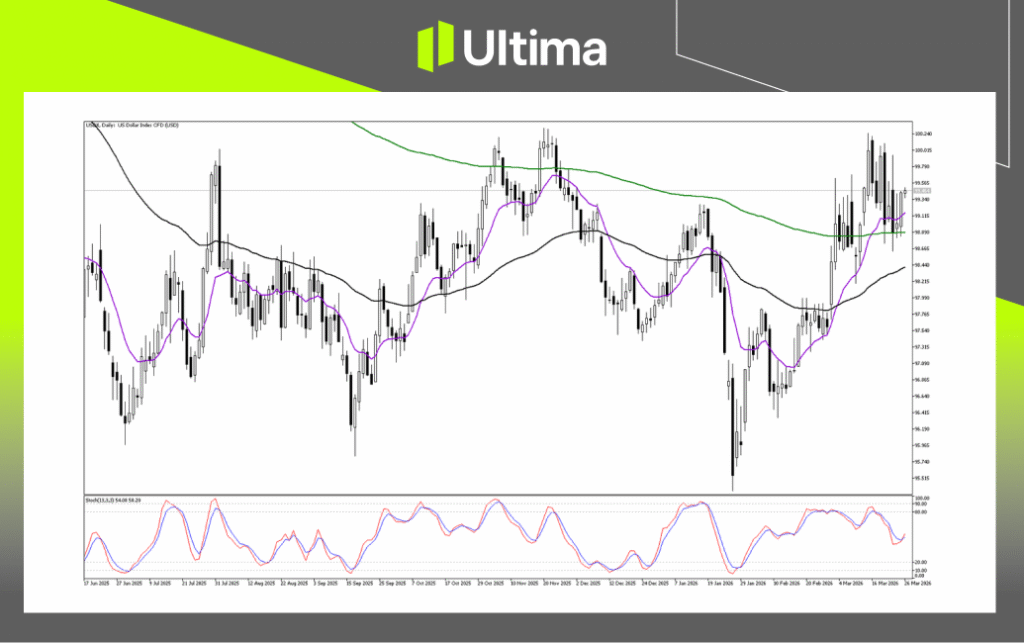
The dollar recently staged a strong comeback, breaking above key technical benchmarks and reversing what had been a prolonged period of weakness. But after such a powerful run, a short-term pause is likely. Expect some softness over the next week or two, with the dollar pulling back to test support in the 98.89–99.12 range — a healthy reset before any further gains. If that floor holds, the dollar could make a run back toward the psychologically important 100 level by the end of the month.
The dollar index daily chart
Brent Crude Oil
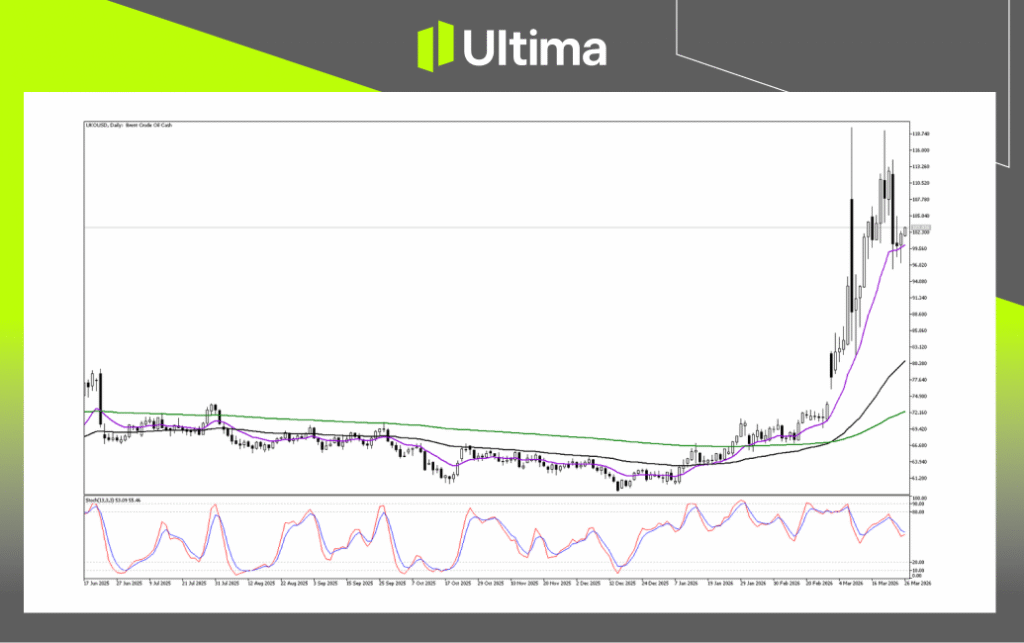
Oil surged dramatically, briefly touching near $119 per barrel — an extreme level that markets quickly pushed back against. The sharp rejection from those highs signals that sellers are firmly in control for now, and more weakness lies ahead. The most likely scenario is a drop toward the $100 mark, where buying interest may re-emerge. Don’t expect a quick snapback to recent highs, though. The more probable outcome is a choppy, sideways grind as the market works through the shock of such extreme volatility.
Brent crude oil daily chart
Gold
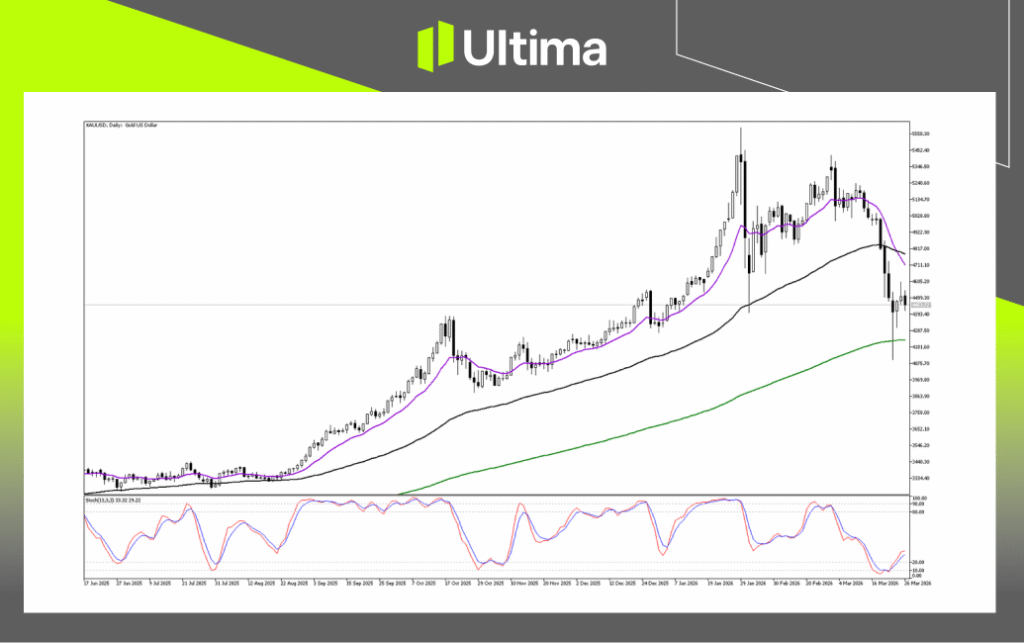
Gold’s story is more complex. After acting as a safe haven during the market turmoil, it suffered a sharp and sudden sell-off — slicing through key technical support levels and signalling a meaningful shift in near-term momentum. The severity of the drop has left gold technically “oversold,” meaning a short-term bounce is likely. However, this recovery is expected to be modest and short-lived, stalling out before reclaiming the $4,800 level. After that, a period of choppy, range-bound trading — or even a retest of recent lows — is the more probable path before any sustained recovery can take hold.
Gold daily chart
The Bigger Picture
What made early 2025 so unsettling for markets was not any single event, but the convergence of several destabilising forces at once. Trade conflict, policy ambiguity, rising bond interest rates, and technological disruption each would have been challenging on their own. Together, they created a feedback loop of caution and risk aversion that reshaped investor expectations for growth, inflation, and the global economy.
Whether the coming months bring a recovery or continued volatility will depend largely on how these fault lines evolve — particularly the outcome of trade negotiations、wars, and the direction of central bank policy. For now, the message from markets is clear: uncertainty is the only certainty.
Disclaimer
Comments, news, research, analysis, price, and all information contained in the article only serve as general information for readers and do not suggest any advice. Ultima Markets has taken reasonable measures to provide up-to-date information, but cannot guarantee accuracy, and may modify without notice. Ultima Markets will not be responsible for any loss incurred due to the application of the information provided.
Thank you for visiting the Ultima Markets website. Please note that this website is intended for individuals residing in jurisdictions where access is permitted by law. Ultima and its affiliated entities do not operate in your home jurisdiction.
By clicking ‘Acknowledge’, you confirm that you are entering this website solely on your own initiative and not as a result of any specific marketing outreach. You wish to obtain information from this website based on reverse solicitation principles, in accordance with the applicable laws of your home jurisdiction.