This website is managed by Ultima Markets’ international entities, and it’s important to emphasise that they are not subject to regulation by the FCA in the UK. Therefore, you must understand that you will not have the FCA’s protection when investing through this website – for example:
You will not be guaranteed Negative Balance Protection
You will not be protected by FCA’s leverage restrictions
You will not have the right to settle disputes via the Financial Ombudsman Service (FOS)
You will not be protected by Financial Services Compensation Scheme (FSCS)
Any monies deposited will not be afforded the protection required under the FCA Client Assets Sourcebook. The level of protection for your funds will be determined by the regulations of the relevant local regulator.
Note: UK clients are kindly invited to visit https://www.ultima-markets.co.uk/. Ultima Markets UK expects to begin onboarding UK clients in accordance with FCA regulatory requirements in 2026.
If you would like to proceed and visit this website, you acknowledge and confirm the following:
1.The website is owned by Ultima Markets’ international entities and not by Ultima Markets UK Ltd, which is regulated by the FCA.
2.Ultima Markets Limited, or any of the Ultima Markets international entities, are neither based in the UK nor licensed by the FCA.
3.You are accessing the website at your own initiative and have not been solicited by Ultima Markets Limited in any way.
4.Investing through this website does not grant you the protections provided by the FCA.
5.Should you choose to invest through this website or with any of the international Ultima Markets entities, you will be subject to the rules and regulations of the relevant international regulatory authorities, not the FCA.
Ultima Markets wants to make it clear that we are duly licensed and authorised to offer the services and financial derivative products listed on our website. Individuals accessing this website and registering a trading account do so entirely of their own volition and without prior solicitation.
By confirming your decision to proceed with entering the website, you hereby affirm that this decision was solely initiated by you, and no solicitation has been made by any Ultima Markets entity.
Ultima Markets does not have an establishment in Singapore and does not operate from Singapore.
Ultima Markets does not provide products or services to citizens or residents of Singapore, and account applications from Singapore citizens or residents will not be accepted.
If you are a citizen or resident of Singapore, please do not open an account or use Ultima Markets’ products or services.
By selecting “Acknowledge and Continue Browsing”, you confirm that you are accessing this website on your own initiative and that your access is not the result of any direct marketing, targeted advertising, solicitation, or promotional activity by Ultima Markets.
Nothing on this website constitutes an offer, solicitation, or promotion of products or services in any jurisdiction where such activity is prohibited. You are responsible for ensuring that your access to and use of this website complies with applicable local laws and regulations.
The Bank of Japan’s monetary policy meeting on April 28, 2026, concluded with a decision to maintain the benchmark interest rate at 0.75%. While the hold was expected, the internal rift within the board initially sent the Yen surging. However, Governor Kazuo Ueda’s “neutral-leaning” stance eventually left the Yen vulnerable to further depreciation.
As of this writing, the USD/JPY is has broken out its 2-year high of 160.00 psychological mark. Despite a seemingly hawkish BoJ, the Yen remains on a long-term depreciation trend.
This raises the question: Why did the BoJ fail to save the Yen, can the pressure be relieved, and what is next for the currency?
BoJ April Policy Update: Hawkish Dissent vs. Ueda’s Neutrality
The Bank of Japan’s April meeting revealed a significant shift in internal dynamics, even as rates held at 0.75%. The market looked closely at this meeting for a further tightening path.
A Divided Board: The vote was 6-3 (growing from the previous 8-1), with three members (Takata, Tamura, and Nakagawa) pushing for an immediate hike to 1.0%.
This represents the strongest internal division since the hold began, signaling that the “hawkish” camp within the BoJ is gaining significant momentum.
This internal division caused the Japanese Yen to gain initially. However, despite the dissent, Governor Ueda maintained a neutral—or even cautious—tone in the press conference that followed.
While affirming that the BoJ is on a tightening path, he highlighted risks from slowing global growth and geopolitical instability. By failing to provide a definitive timeline for the next hike, he signaled to markets that the BoJ is not yet ready to chase the inflation curve aggressively, putting immediate selling pressure back on the Yen.
Why is the Yen Still Falling?
Even though the overall BoJ stance is considered hawkish, it failed to help the Yen. Many traders are asking if the pressure will ever ease. While Ueda’s neutral tone contributed to near-term pressure post-decision, understanding how this pressure might ease requires looking at why the Yen remains at multi-decade lows. It largely comes down to three reasons:
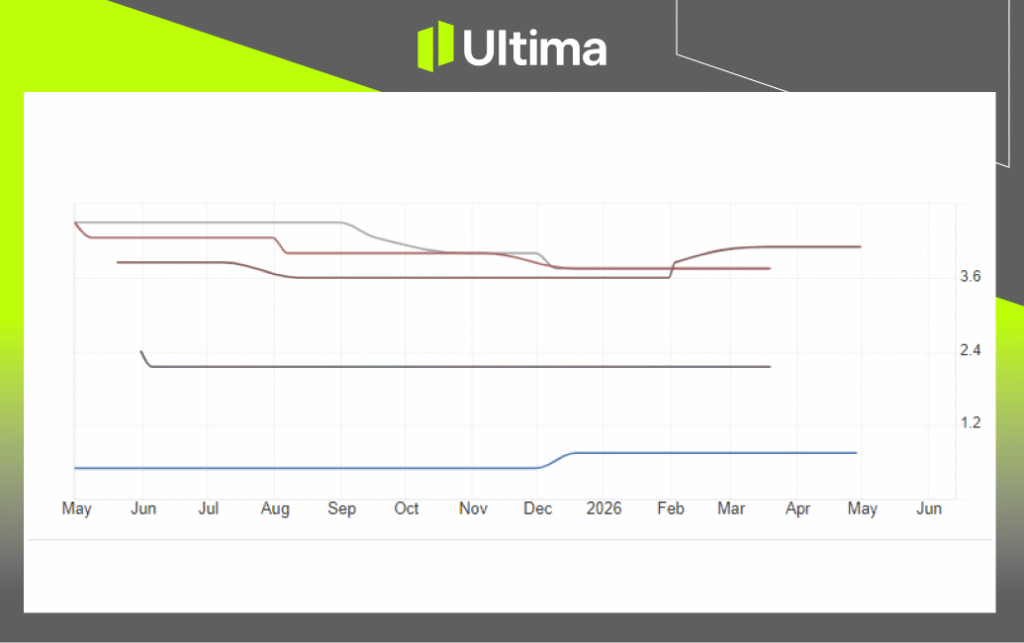
BoJ Interest Rate vs. Other Major Central Bank Rates | Chart Source: TradingEconomics
Widening Rate Differentials: Even with the BoJ at 0.75%, the gap between Japanese rates and those of the US or Europe (still hovering around 4-5%) remains massive. The Yen continues to be the primary funding currency for Carry Trades, where investors sell Yen to buy higher-yielding assets.
Yen Debt & the Yield Curve: Japan’s massive public debt limits the BoJ’s flexibility. If the BoJ raises rates too quickly, the cost of servicing government debt becomes unsustainable. This creates a “policy trap” where markets bet that the BoJ cannot raise rates high enough to matter.
Trade Deficits: Persistently high global energy prices (with WTI crude near $100) mean Japan, as a resource-poor nation, must sell Yen to buy fuel, creating a constant structural outflow of the currency.
All in all, the reasons go beyond these, but when the majority of market participants are not buying into the Yen, it pushes the currency into further pressure. In simple words, nothing is currently pointing toward a good outlook for the Yen.
The Path of Relief: How Can Yen Pressure Ease?
Is the Yen going to keep depreciating? For the Yen to see a sustainable recovery, the market needs more than verbal intervention. Until we see a shift in the macro landscape, the Yen will remain under pressure.
“Real” Hike & a Clear Path: The BoJ must move beyond rhetoric. Relief will only come when the BoJ delivers a substantive hike or outlines a clear plan. The BoJ needs to provide a transparent terminal rate. If the market believes the BoJ will stop at 1%, the Yen will stay weak. If they signal a path toward higher rates, the Yen will rally. However, a hike could still trouble Japanese Debt (the JGBs). Without substantial growth in wages and stable inflation, a hike alone is not enough.
Managing Debt Without Yield Suppression: This leads to the second factor: Yield Curve Control (YCC). The BoJ needs to transition away from YCC without causing a crash in JGB (Japanese Government Bond) prices. A “soft landing” for the bond market—where yields rise naturally due to market demand rather than central bank manipulation—is essential to restore confidence. This requires substantial growth that allows the BoJ to hike without worry. This is a major issue troubling the BoJ and causing Yen weakness.
External Factors: Lastly, external factors—particularly the rate differentials from other major economies—are key. A significant portion of Yen weakness is driven by “Dollar strength” and Fed Fund Rates. If US inflation cools enough for the Federal Reserve to cut rates, the narrowing spread will do more for the Yen than any BoJ intervention could.
What to Expect Next for the Japanese Yen?
The future for the Yen remains tough:
Short-Term (Q2 2026): The Yen is likely to remain under pressure, risking a breakout of the 160.00 level for USD/JPY. Markets will treat the 6-3 split as a precursor to a June or July hike, but the three major relief factors are unlikely to happen in the next 1-2 months.
The “Turning Point”: Watch the 2026 wage growth data. If real wages turn positive and consumption recovers, Ueda will lose his “neutral” excuse and be forced into a hawkish pivot. The market will only shift expectations when wage growth provides a promising reason to do so.
Generally, expect high volatility in Yen pairs, especially with USD/JPY at 160.00. While the structural trend remains weak, the increasing hawkishness within the BoJ is not yet enough to support the Yen because the market simply doesn’t see a surprise.
USD/JPY Outlook: Focus on the 160.00
We need to see how the market actually reacts. The USD/JPY is currently at 160.00, which is an intervention zone, meaning the Yen could still pose a rebound (a corrective move in USD/JPY).
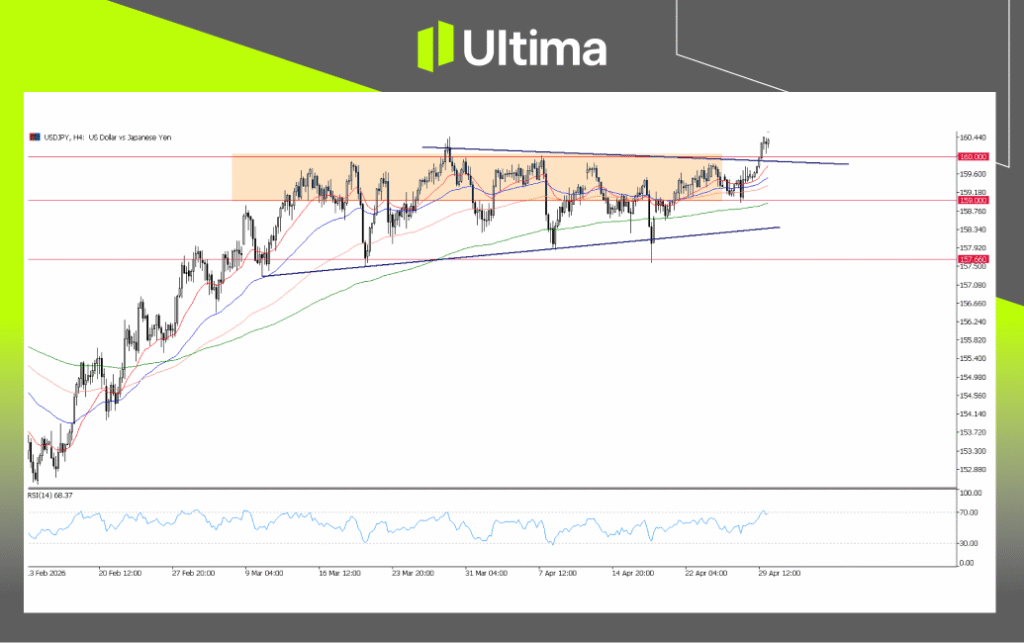
USD/JPY, Daily Chart | Ultima Markets MT5
The pair has traded within the 159.00–160.00 range for nearly two months, reflecting persistent uncertainty. Given the underlying structural weakness in the Yen, a breakout above 160.00 could trigger renewed bullish momentum.
However, this level also carries heightened risk of official intervention. A rejection or breakdown from this zone could support a short-term corrective move lower in USD/JPY.
With the recent breakout above 160.00, the key question now is whether the move can sustain. If the retest holds, upside risks remain elevated; if not, a corrective pullback becomes increasingly likely.
In summary: the structural trend remains bearish for the Yen (bullish for USD/JPY), but 160.00 can act as a resistance zone for a corrective move. Until then, we remain cautiously bearish for the Yen, at least into Q2 2026.
Disclaimer
Comments, news, research, analysis, price, and all information contained in the article only serve as general information for readers and do not suggest any advice. Ultima Markets has taken reasonable measures to provide up-to-date information, but cannot guarantee accuracy, and may modify without notice. Ultima Markets will not be responsible for any loss incurred due to the application of the information provided.
Thank you for visiting the Ultima Markets website. Please note that this website is intended for individuals residing in jurisdictions where access is permitted by law. Ultima and its affiliated entities do not operate in your home jurisdiction.
By clicking ‘Acknowledge’, you confirm that you are entering this website solely on your own initiative and not as a result of any specific marketing outreach. You wish to obtain information from this website based on reverse solicitation principles, in accordance with the applicable laws of your home jurisdiction.