This website is managed by Ultima Markets’ international entities, and it’s important to emphasise that they are not subject to regulation by the FCA in the UK. Therefore, you must understand that you will not have the FCA’s protection when investing through this website – for example:
You will not be guaranteed Negative Balance Protection
You will not be protected by FCA’s leverage restrictions
You will not have the right to settle disputes via the Financial Ombudsman Service (FOS)
You will not be protected by Financial Services Compensation Scheme (FSCS)
Any monies deposited will not be afforded the protection required under the FCA Client Assets Sourcebook. The level of protection for your funds will be determined by the regulations of the relevant local regulator.
Note: UK clients are kindly invited to visit https://www.ultima-markets.co.uk/. Ultima Markets UK expects to begin onboarding UK clients in accordance with FCA regulatory requirements in 2026.
If you would like to proceed and visit this website, you acknowledge and confirm the following:
1.The website is owned by Ultima Markets’ international entities and not by Ultima Markets UK Ltd, which is regulated by the FCA.
2.Ultima Markets Limited, or any of the Ultima Markets international entities, are neither based in the UK nor licensed by the FCA.
3.You are accessing the website at your own initiative and have not been solicited by Ultima Markets Limited in any way.
4.Investing through this website does not grant you the protections provided by the FCA.
5.Should you choose to invest through this website or with any of the international Ultima Markets entities, you will be subject to the rules and regulations of the relevant international regulatory authorities, not the FCA.
Ultima Markets wants to make it clear that we are duly licensed and authorised to offer the services and financial derivative products listed on our website. Individuals accessing this website and registering a trading account do so entirely of their own volition and without prior solicitation.
By confirming your decision to proceed with entering the website, you hereby affirm that this decision was solely initiated by you, and no solicitation has been made by any Ultima Markets entity.
Ultima Markets does not have an establishment in Singapore and does not operate from Singapore.
Ultima Markets does not provide products or services to citizens or residents of Singapore, and account applications from Singapore citizens or residents will not be accepted.
If you are a citizen or resident of Singapore, please do not open an account or use Ultima Markets’ products or services.
By selecting “Acknowledge and Continue Browsing”, you confirm that you are accessing this website on your own initiative and that your access is not the result of any direct marketing, targeted advertising, solicitation, or promotional activity by Ultima Markets.
Nothing on this website constitutes an offer, solicitation, or promotion of products or services in any jurisdiction where such activity is prohibited. You are responsible for ensuring that your access to and use of this website complies with applicable local laws and regulations.
Learn what the Put Call Ratio is, how it’s calculated, and how traders read it to gauge market sentiment and spot opportunities.
The Put Call Ratio (PCR) is one of the most trusted sentiment indicators in the options market. By comparing the trading activity of put options to call options, it gives traders a snapshot of whether investors are feeling cautious or confident. With markets reacting sharply to interest rate decisions, inflation data, and earnings reports, PCR remains an essential tool for traders looking to measure crowd psychology and prepare for volatility.
What is Put Call Ratio?
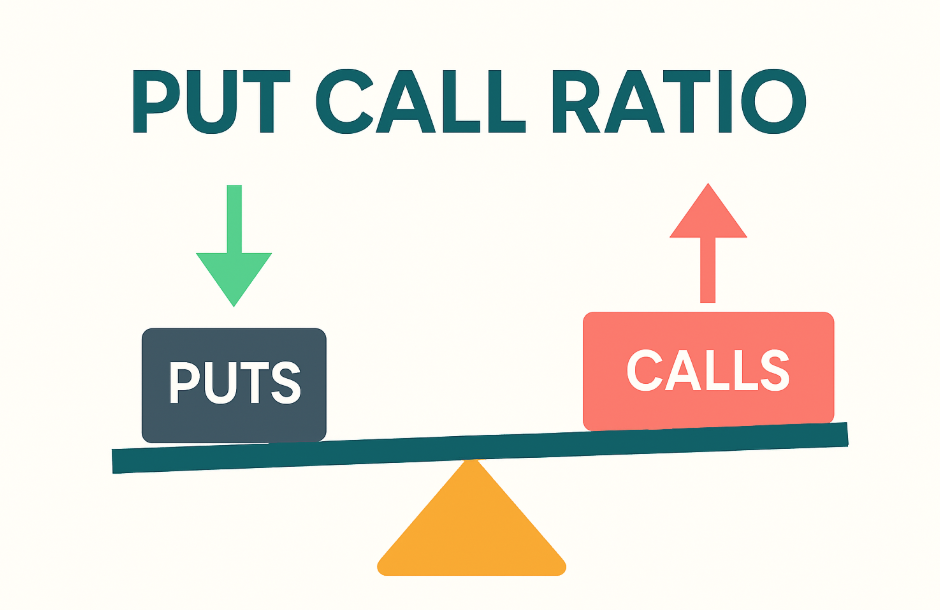
The Put Call Ratio (PCR) is a market sentiment indicator that compares the trading volume of put options to call options. It is calculated by dividing the number of traded puts by calls. A high ratio signals bearish sentiment, while a low ratio indicates bullish optimism.
Put options gain value when an asset’s price falls.
Call options gain value when an asset’s price rises.
By comparing these two, PCR shows whether investors are leaning more toward protection (puts) or speculation (calls). A high ratio suggests fear or bearishness, while a low ratio shows optimism.
Unlike many technical indicators, PCR reflects real market positioning rather than price patterns, which makes it especially useful during uncertain times.
How to Calculate the Put Call Ratio
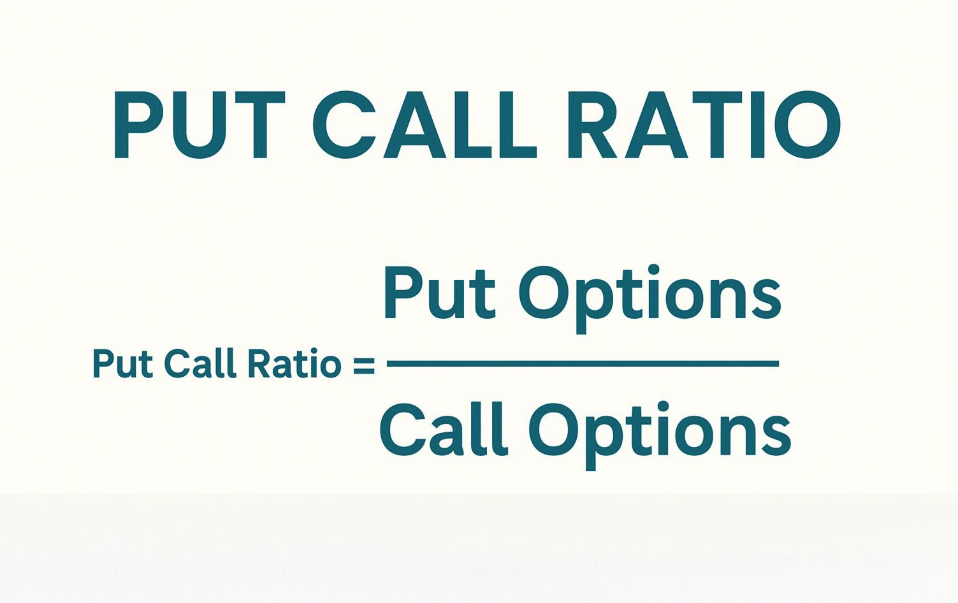
The Put Call Ratio (PCR) is calculated using a simple formula:
Put Call Ratio = Put Options/ Call Options
This means you divide the total number of traded put options by the total number of traded call options over a specific period (daily, weekly, or by open interest).
Example Calculation:
If 1,200,000 put contracts are traded and 1,000,000 call contracts are traded in a day:
PCR = 1,200,000/ 1,000,000
PCR = 1.2
A PCR of 1.2 shows that puts are being traded more than calls, signaling cautious or bearish positioning.
Types of PCR Calculations
Volume-based PCR: Uses the number of puts and calls traded within a day.
Open-Interest PCR: Uses the outstanding contracts that remain open, giving insight into longer-term positioning.
Index vs Stock PCR: Index PCR reflects broader market sentiment, while individual stock PCR highlights sentiment toward specific companies.
In 2025, traders often use both daily PCR volume and open-interest PCR together for a clearer view of market sentiment.
How to Read the Put Call Ratio
The Put Call Ratio (PCR) is read by comparing its value to 1.0, which represents balance between puts and calls.
PCR below 0.7: More calls than puts, Signals bullish sentiment.
PCR between 0.7 and 1.0: Neutral sentiment, Market is balanced.
PCR above 1.0: More puts than calls, Indicates bearish sentiment.
Traders often interpret extreme readings as contrarian signals:
Very high PCR (>1.5): Excessive fear in the market, possible rebound ahead.
Very low PCR (<0.5): Overconfidence, potential pullback risk.
PCR should not be read in isolation. In 2025, many traders combine PCR with:
VIX (Volatility Index) for fear gauge.
Technical levels like support and resistance.
Macro events such as rate decisions or earnings reports.
In 2024–2025, CBOE data showed average equity PCR levels hovering around 0.8–1.0, meaning only sharp deviations outside this range stand out as meaningful signals.
What is a Good Put Call Ratio?
A good Put Call Ratio typically falls around 1.0, showing a balanced market. A ratio below 0.7 suggests bullish optimism, while a ratio above 1.0 signals bearish sentiment. Extreme levels under 0.5 or over 1.5 are often read as contrarian indicators of potential reversals.
Ultimately, a “good” PCR is one that aligns with your trading timeframe and strategy. Short-term traders may act on extremes, while long-term investors may use it as confirmation rather than a trigger.
Example: PCR in Market Action
To see the Put Call Ratio (PCR) in action, let’s look at how traders might interpret it during real events:
Example 1: Index PCR before a Fed meeting
Suppose the S&P 500’s daily PCR jumps to 1.6 ahead of a Federal Reserve interest rate decision. This shows traders are heavily buying puts for protection. If the Fed delivers a less aggressive policy, fear may quickly unwind, leading to a relief rally. Contrarian traders often see this as a bullish setup.
Example 2: Stock-specific PCR during earnings
Imagine Apple’s stock PCR rises to 1.3 just before earnings. Investors may be hedging against a possible miss. If results beat expectations, the rush to cover puts and buy calls could fuel a sharp upside move.
Example 3: Low PCR in a strong bull market
During a strong rally, a PCR of 0.5 may suggest traders are overly confident. While this reflects bullish sentiment, seasoned traders treat it as a warning sign that the market may be vulnerable to a pullback.
CBOE data shows PCR extremes are more common around macro events (Fed decisions, inflation reports) and earnings season, making it a timely tool for sentiment analysis.
Limitations of the Put Call Ratio
While the Put Call Ratio (PCR) is a powerful sentiment tool, it has several limitations that traders should be aware of:
Doesn’t predict direction – PCR shows whether traders prefer puts or calls, but it does not guarantee which way prices will move.
Extremes can persist – High or low ratios may last for weeks in strong bull or bear markets, making timing difficult.
Different markets, different signals – An index PCR reflects broad sentiment, but stock-specific PCRs can be skewed by hedging or speculative activity.
Overreliance risk – Using PCR alone may lead to false signals. Professional traders combine it with other tools such as VIX, moving averages, or macroeconomic data.
Timeframe sensitivity – Daily PCR readings can show noise, while open-interest PCR may give a slower but steadier signal.
PCR is most effective when used as part of a broader strategy that includes technical indicators, volatility measures, and fundamental analysis.
Conclusion
The Put Call Ratio remains one of the most valuable sentiment indicators. By tracking the balance between puts and calls, traders can better understand whether fear or optimism dominates the market. While extremes in PCR can highlight potential turning points, it should never be used in isolation. Combining PCR with technical analysis, volatility measures, and key macro events gives a more reliable trading picture.
At Ultima Markets, we are committed to helping traders navigate complex market signals with clarity and confidence. Backed by global regulation and trusted trading platforms, we provide the tools and education you need to trade smarter, not harder.
Share Now
Disclaimer:This content is provided for informational purposes only and does not constitute, and should not be construed as, financial, investment, or other professional advice. No statement or opinion contained herein should be considered a recommendation by Ultima Markets or the author regarding any specific investment product, strategy, or transaction. Readers are advised not to rely solely on this material when making investment decisions and should seek independent advice where appropriate.
Thank you for visiting the Ultima Markets website. Please note that this website is intended for individuals residing in jurisdictions where access is permitted by law. Ultima and its affiliated entities do not operate in your home jurisdiction.
By clicking ‘Acknowledge’, you confirm that you are entering this website solely on your own initiative and not as a result of any specific marketing outreach. You wish to obtain information from this website based on reverse solicitation principles, in accordance with the applicable laws of your home jurisdiction.